ETH Staking Timelines
When you stake ETH, your deposit is used to activate a validator on the Ethereum network. The process follows a few protocol-defined steps before rewards begin accruing:
Deposit Processing – Each validator requires a minimum 32 ETH deposit to the official Ethereum deposit contract. Once the transaction is finalized on-chain, it becomes part of the validator queue.
Activation Queue – New validators enter a queue before joining the active set. A maximum of 256 ETH can be activated per epoch (~6.4 minutes), or about 57,600 ETH per day across the entire network. Queue length varies based on demand and can range from minutes to several days. Live entry queue wait can be viewed here.
Activation – After passing through the queue, the validator becomes active. For new validator activations (not top-ups), there’s an additional 4-epoch (~25.6 minute) delay before activation begins. Rewards start accruing from the first active epoch.
Determining Activation ETA
In Prime, go to the Activity section.
Filter for “Stake” and/or “ETH.”
Click into the relevant staking activity.
Select “View Validator Details.”
You will see a list of validators associated with your vault wallet, with a direct link to beaconcha.in.
Click the beaconcha.in link (a blue square with an arrow) to view full details for that validator, including each validator’s estimated activation epoch, date and time.
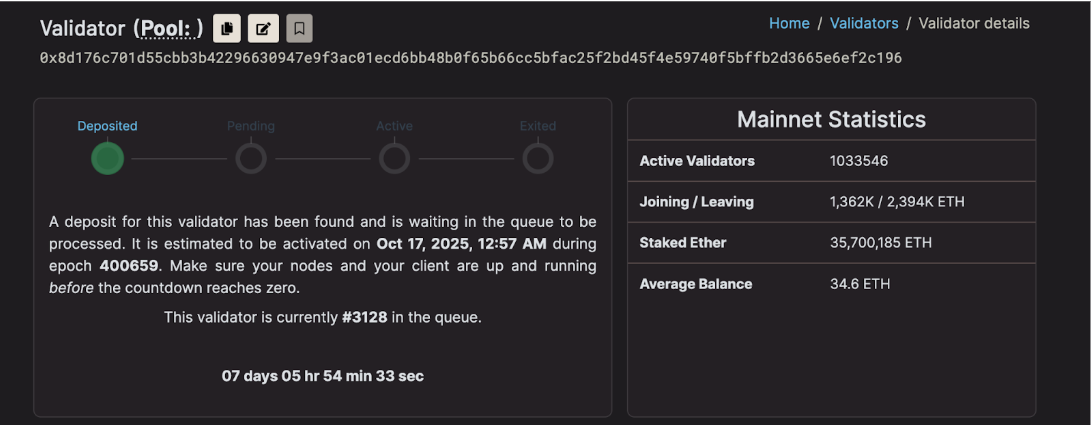
Viewing Estimated Activation Times in Prime
You can also find Estimated Activation Times on the Activity Details page in Prime, which will display:
Amount
Validator
Estimated Activation Time
ETH Unstaking Timelines
When you unstake ETH, there are three protocol-driven steps before funds are returned:
Exit Epoch – when your validator leaves the active set.
Exits are rate-limited by the protocol: a maximum of 256 ETH can exit per epoch (~6.4 minutes). This equates to about 57,600 ETH per day across the entire network. This cap is often the main bottleneck for exits.
Withdrawable Epoch – ~27 hours (256 epochs) after exit, when your ETH becomes eligible for withdrawal.
Sweep Completion – after becoming withdrawable, funds are released during the round-robin sweep. The sweep cycles through validators by index, processing up to 16 withdrawals per block (~12s). This process can take up to ~9 days to complete, depending on queue position and number of validators on the network.
Quick Estimate (Rule of Thumb)
1. Find your validator index and exit date:
In Prime, go to the Activity section.
Filter for “Stake” and/or “ETH.”
Click into the relevant staking activity.
Select “View Validator Details.”
You’ll see a list of validators associated with your vault wallet, with a direct link to beaconcha.in.
Click the beaconcha.in link (a blue square with an arrow) to view full details for that validator, including each validator’s index and exit date.
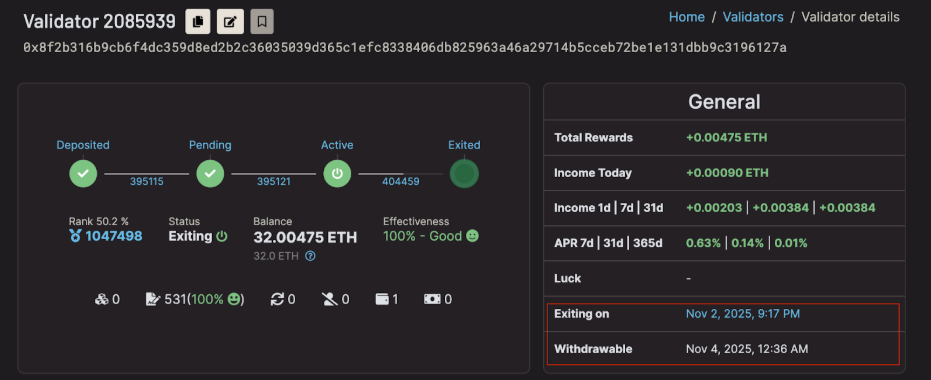
2. Apply the rule of thumb:
Exit date + ~10 days = Completion date
(~27 hours for withdrawable + up to ~9 days for sweep).Sweep delay is variable. ~9 days is the worst-case scenario if your validator sits far back in the queue.
You can also reference https://www.validatorqueue.com/ to see the current network sweep delay estimate.
Use this for a fast, conservative estimation.
Viewing Estimated Unstake Times in Prime
You can also find Estimated Unstaking Times on the Activity Details page in Prime, which will display:
Amount
Validator
Estimated Unstake Time
Note: Each validator will appear only once, as a single stake request can either fully unstake from a validator or perform a partial withdrawal — not both.
If you want to calculate a more precise sweep delay:
1. Calculate the sweep cycle time (protocol-wide):
Estimated Sweep Time (seconds) = Total Active Validators ÷ 16 × 12
16 = maximum withdrawals included per block.
12 = average Ethereum block time (seconds).
2. Find the last swept validator index:
On beaconcha.in, go to withdrawals.
The highest index in the most recently processed batch is the current sweep position.
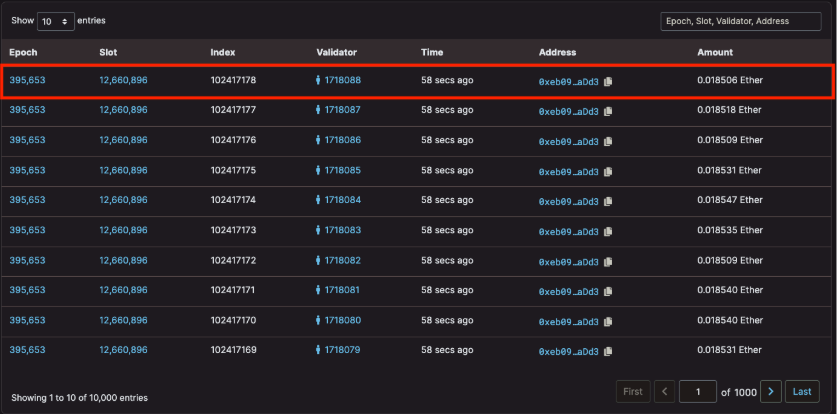
3. Calculate the difference:
Validators Ahead = Your Validator Index − Last Swept Index
i.e. 367851 = 2085939 - 1718088
4. Estimate sweep delay:
Time to Sweep (seconds) = Validators Ahead ÷ 16 × 12
To make this easier to interpret:
Hours = Time to Sweep ÷ 3,600
Days = Time to Sweep ÷ 86,400
275888.25 = 367851 ÷ 16 x 12
5. Add this to the withdrawable epoch:
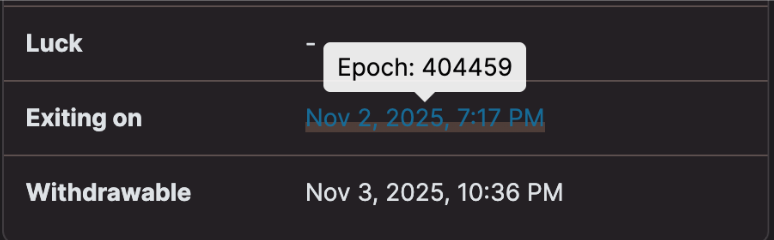
Withdrawable = Exit Epoch + 256 epochs (~27 hours)
404459 + 256 = 404715 (x 12 seconds) = 4856580 (Epoch in seconds)
Completion = Withdrawable + Sweep Delay (in hours/days)
5132468.25 = 4856580 + 275888.25
5132468.25 / 86400 = 59.404 Days
Considerations
These are estimates.
If the last swept index is already greater than your validator index, it means the sweep has already passed – you’ll need to wait until the next full sweep cycle.
As a conservative buffer, allow up to 24 hours beyond the estimated sweep delay timing to account for Cold Storage processing.
Note: Prime currently only shows an unstaking ETA once during the workflow preview. After confirmation, no ongoing ETA is displayed. We’ll be re-introducing these metrics in the Prime UI soon.